
Quick Answer: The third-quarter (Q3) 2026 estimated tax payment is due on September 15, 2026. If you are self-employed, a freelancer, a gig worker, an investor, or anyone who earns income without automatic withholding, you likely need to make this payment. Missing it can result in an IRS underpayment penalty — even if you plan to pay in full at tax time. Payments can be made quickly and securely at IRS.gov/payments.
September 15 is right around the corner — and if you earn income that isn't automatically withheld for taxes, the IRS expects a payment from you right now. The U.S. tax system is pay-as-you-go, which means taxes are generally owed throughout the year as income is earned, not just in April.
Missing a quarterly estimated tax deadline doesn't result in a penalty notice arriving months later — the IRS calculates underpayment charges quarterly and adds them to your total tax bill. The good news? Making your Q3 payment on time is straightforward once you know what you owe and how to pay. This guide walks you through everything.
What Are Estimated Taxes?
Estimated taxes are periodic payments made directly to the IRS (and often your state tax agency) to cover income tax — and, for self-employed individuals, self-employment tax — on income that has no automatic withholding.
When you work a traditional W-2 job, your employer withholds federal income tax from each paycheck. But when income comes from freelance work, business profits, rental income, investment gains, or other non-wage sources, no one withholds those taxes on your behalf. The IRS requires you to estimate and pay that tax yourself — four times per year.
The Four Quarterly Due Dates for 2026
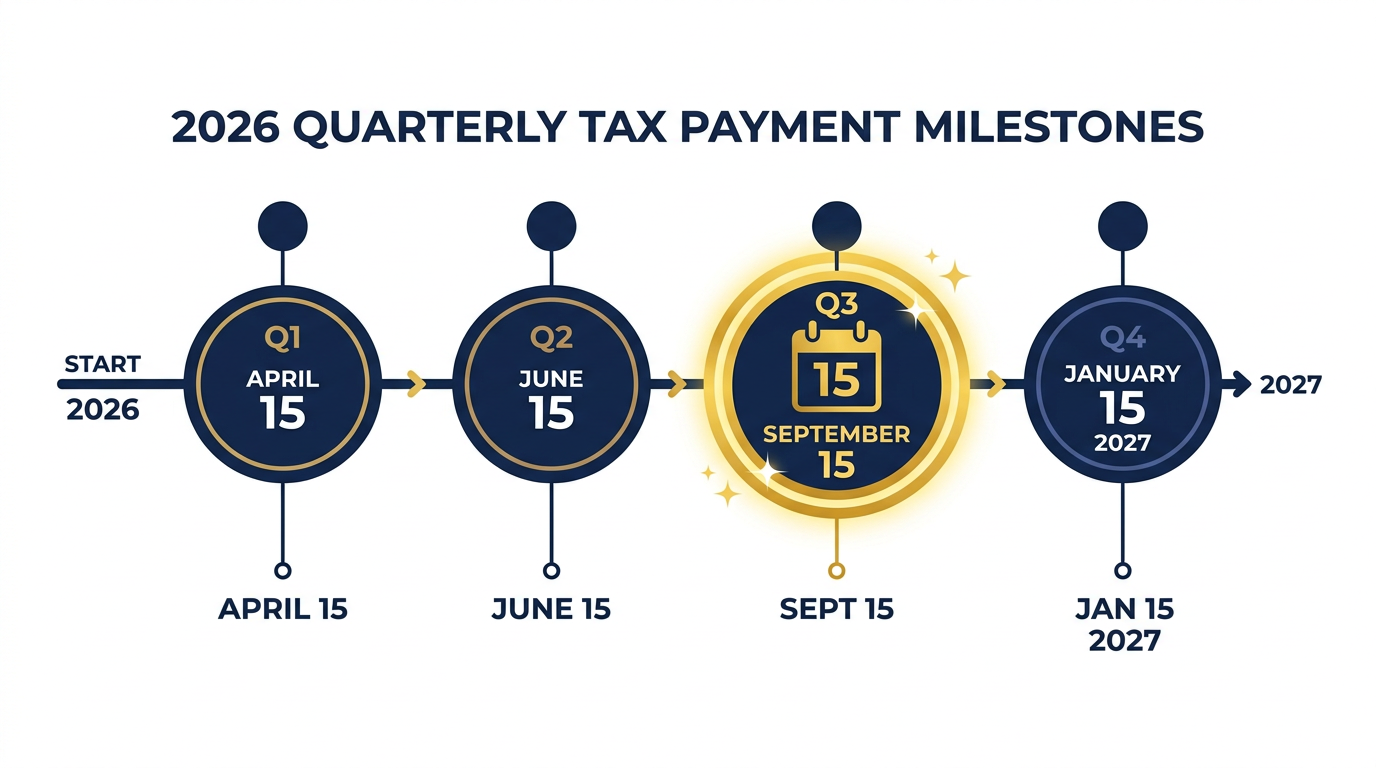
| Quarter | Income Period (Approximate) | Payment Due Date |
|---|---|---|
| Q1 | January 1 – March 31 | April 15, 2026 |
| Q2 | April 1 – May 31 | June 16, 2026 |
| Q3 ⚠️ UPCOMING | June 1 – August 31 | September 15, 2026 |
| Q4 | September 1 – December 31 | January 15, 2027 |
Note: These dates follow the standard IRS schedule. If a due date falls on a weekend or federal holiday, it shifts to the next business day. Always verify current deadlines at IRS.gov.
Who Needs to Make Estimated Tax Payments?
The IRS generally requires you to pay estimated taxes if you expect to owe at least $1,000 in federal tax after subtracting withholding and credits for the year. This threshold applies broadly. You may need to pay estimated taxes if you are:
- Self-employed — freelancers, independent contractors, consultants, and sole proprietors
- Gig economy workers — rideshare drivers, delivery couriers, online sellers, and app-based service providers
- Small business owners — sole proprietors, partners in a partnership, and S-corporation shareholders who receive pass-through income
- Investors — those with capital gains, significant dividend income, or interest income not subject to withholding
- Landlords — property owners with rental income that exceeds expenses
- Retirees — individuals taking distributions from retirement accounts without voluntary withholding
- W-2 employees with significant side income — even if your day job withholds taxes, side-gig income may create an estimated tax obligation
Who Is Generally Exempt?
You typically do NOT need to make estimated tax payments if your total tax liability for the year will be less than $1,000, or if your employer withholds enough from your paycheck to cover your full tax bill. Employees can also increase their W-4 withholding as an alternative to making separate estimated payments.
How to Calculate Your Q3 Estimated Tax Payment
There are two main methods the IRS allows for calculating how much to pay each quarter. You can use either — whichever results in avoiding an underpayment penalty.
Method 1: Pay Based on What You Actually Owe This Year (Annualized Method)
Add up your actual income earned from June 1 through August 31, estimate your full-year tax liability, and pay roughly 25% of that total each quarter. This approach is more accurate if your income fluctuates significantly from month to month — common for seasonal businesses and project-based freelancers.
Method 2: Use Last Year's Tax Bill as a Safe Harbor (Safe Harbor Method)
The IRS provides a "safe harbor" from penalties if you pay at least:
- 100% of last year's tax liability (divided into four equal payments), if your 2025 adjusted gross income was $150,000 or less
- 110% of last year's tax liability, if your 2025 adjusted gross income exceeded $150,000
This method is simple and popular because you don't need to estimate this year's income — you just divide last year's total tax (from your 2025 tax return) by four and pay that amount each quarter.
Practical Example
Example: Freelance graphic designer
Maria is a freelance graphic designer who had a total federal tax liability of $12,000 in 2025 and her AGI was under $150,000. Using the safe harbor method, she divides $12,000 by 4 and pays $3,000 per quarter. Her Q3 payment of $3,000 is due by September 15, 2026. As long as she makes all four payments on time, she avoids an underpayment penalty — even if she ends up owing more or less when she files her 2026 return in April 2027.
For more precise calculations, the IRS provides Form 1040-ES (Estimated Tax for Individuals), which includes a worksheet to guide you through the math. It is available at IRS.gov.
How to Make Your Q3 Estimated Tax Payment
The IRS offers several convenient ways to pay. Choose the method that works best for you:
- IRS Direct Pay (IRS.gov/directpay) — Free, instant bank transfer directly from your checking or savings account. No registration required. This is the fastest and simplest option.
- IRS Online Account — Log in or create an account at IRS.gov to view your payment history and make payments.
- Electronic Federal Tax Payment System (EFTPS) — Free service that requires advance enrollment. Ideal for businesses and those who make frequent payments. Allows scheduling payments up to 365 days in advance.
- IRS2Go Mobile App — The official IRS mobile app allows payments via Direct Pay or debit/credit card.
- Debit or Credit Card — Available through IRS-authorized payment processors. A processing fee applies.
- Mail a check or money order — Payable to "United States Treasury" and mailed with a completed Form 1040-ES voucher. Confirm the correct mailing address for your state on IRS.gov.
💡 Pro Tip: If you pay online through IRS Direct Pay or EFTPS, you receive instant confirmation of your payment. Save or screenshot the confirmation number for your records. If you mail a check, make it payable to United States Treasury and write your Social Security number and "2026 Form 1040-ES Q3" in the memo line.
What Happens If You Miss the September 15 Deadline?
Missing an estimated tax deadline doesn't trigger a collection notice the way a missed filing deadline would — but it's not cost-free either. The IRS charges an underpayment penalty, which is calculated based on:
- The amount you underpaid for each quarter
- The number of days late
- The current IRS interest rate for underpayments (which adjusts quarterly based on the federal short-term rate plus 3 percentage points)
The penalty is calculated separately for each quarter — so missing Q1 and Q3 while paying Q2 and Q4 on time still means you'll owe two separate underpayment charges. The IRS uses Form 2210 to calculate this penalty when you file your annual return.
Important: Even if you pay the full amount you owe when you file your tax return in April 2027, the underpayment penalty for missed quarterly payments still applies. Paying late does not erase the penalty for the quarters that were missed.
Can You Avoid the Penalty After Missing a Deadline?
In some cases, yes. The IRS may waive or reduce the underpayment penalty if:
- You had a casualty, disaster, or unusual circumstance that made timely payment unreasonable
- You retired or became disabled during the tax year and had reasonable cause for failing to pay
- Your underpayment resulted from a change in tax law that you couldn't reasonably have anticipated
Penalty waiver requests are made using Form 2210 when filing your return. If you believe you qualify, a qualified tax professional can help you evaluate your options.
Don't Forget Your State Estimated Taxes
Most states that have an income tax also require estimated quarterly payments — and many follow a schedule similar to the IRS. However, state deadlines and rules vary. Some states use different quarterly periods, different thresholds, or different payment methods.
If you live in a state with an income tax, check your state's department of revenue website to confirm whether a Q3 state estimated tax payment is also due around September 15. Failing to pay state estimated taxes on time can result in state-level underpayment penalties in addition to any federal charges.
Quick Checklist: Before You Pay on September 15
- ✅ Confirm whether you are required to make estimated tax payments this year
- ✅ Gather your 2025 federal tax return to use the safe harbor method
- ✅ Calculate your Q3 payment amount using the safe harbor or annualized income method
- ✅ Choose your payment method (IRS Direct Pay is fastest)
- ✅ Submit your federal payment at IRS.gov before September 15, 2026
- ✅ Check whether your state requires a Q3 estimated payment and pay it by the state deadline
- ✅ Save your payment confirmation number
Frequently Asked Questions
What is the Q3 2026 estimated tax deadline?
The third-quarter 2026 estimated tax payment is due on Monday, September 15, 2026. This applies to federal estimated taxes. State deadlines may vary — check with your state's department of revenue.
Do I have to pay estimated taxes if I'm a W-2 employee?
Most W-2 employees do not need to make separate estimated payments because their employer handles withholding. However, if you have significant additional income — such as freelance work, rental income, or investment gains — you may owe estimated taxes on that income. You can also adjust your W-4 withholding to cover the additional tax instead of making quarterly payments.
What if I can't afford to pay the full estimated amount?
Pay as much as you can by the deadline. A partial payment reduces the underpayment penalty even if it doesn't eliminate it entirely. If you are struggling with a larger tax balance, speaking with a tax professional about your options — including IRS payment plans — can help you manage the debt responsibly.
How do I know how much to pay for Q3?
The simplest approach is the safe harbor method: divide your total 2025 federal tax liability by four and pay that amount each quarter. If your 2025 AGI exceeded $150,000, you must pay 110% of your 2025 tax liability (divided by four) to qualify for safe harbor. Alternatively, you can estimate your actual 2026 income and use the IRS Form 1040-ES worksheet.
What is the IRS underpayment penalty rate in 2026?
The IRS underpayment penalty rate is tied to the federal short-term interest rate plus 3 percentage points, and it adjusts quarterly. For the most current rate, check the IRS website or consult a tax professional. The penalty is calculated daily on the amount underpaid.
Can I pay my estimated taxes early?
Yes. The IRS accepts early estimated tax payments. Paying before September 15 is perfectly fine and may be smart if you travel, want to ensure the payment posts on time, or simply want one less thing on your to-do list.
Not Sure What You Owe? We Can Help.
Whether you need help calculating your estimated payments, catching up on missed quarters, or resolving an IRS underpayment notice — our team at Champion Tax & Financial Services is here to guide you. Don't wait until April to sort out your tax situation.
Schedule a Free Consultation Today →